

The buyer is ready, the money is agreed, and the seller is four hundred miles away. Pennsylvania requires the title to be signed in front of a notary, so the sale appears to be stuck. It usually is not.
Why the problem arises at all
Every Pennsylvania title transfer requires the assignment to be notarized, which means the person whose name is on the title has to appear in person before a notary. There is no remote alternative — vehicle titles cannot be notarized online, as covered in why Pennsylvania requires a notary on car titles.

So when an owner genuinely cannot attend — deployed, hospitalised, living out of state, or simply unable to travel — the answer is to authorise someone who can.
Three types are used
Pennsylvania recognises three power of attorney forms in connection with vehicle title transfers, and they are not interchangeable.
| Type | Scope | Execution |
|---|---|---|
| Secure power of attorney | Narrow — specific vehicle transactions | Notarized, or signature verified by a licensed dealer acting as issuing agent |
| General power of attorney | Broad — includes durable and springing forms | Notarized and signed by two witnesses |
| Third party limited power of attorney | Limited to defined vehicle matters | As required for the transaction |

The secure power of attorney is the one built for this job. It is PennDOT’s own instrument, it exists only for title and registration purposes, and its narrowness is a feature — it authorises the paperwork without handing over anything else.
The general power of attorney is stricter
People often assume the general power of attorney a relative already holds will simply work. It may, but it has to have been executed correctly, and Pennsylvania’s requirements for one are demanding.

A general power of attorney must be notarized and must carry the signatures of two witnesses. Those witnesses cannot be the agent, cannot be the notary, and cannot be anyone who signed on the principal’s behalf — the full rules are in getting a power of attorney notarized in Pennsylvania.
A defective general power of attorney fails at the counter. If it was executed without two qualifying witnesses, or in another state under different rules, it may not be accepted for a Pennsylvania title transaction. Have it looked at before the appointment rather than discovering the problem with a buyer waiting.
What the notary is doing
When a power of attorney is notarized, the notary is identifying and witnessing the signature of the person granting the authority — the vehicle owner — not the person receiving it.

The notary is not confirming that the authority is appropriate, that the agent is trustworthy, or that the document will be accepted by PennDOT. Those are outside a notarial act, for the reasons set out in notary public versus notario público.
What that means practically: the owner has to appear before a notary to grant the power, even though the whole point is that they cannot appear for the transfer. That is not a contradiction — the power of attorney can be notarized wherever they are, including in another state, and then sent.
Signing as the agent
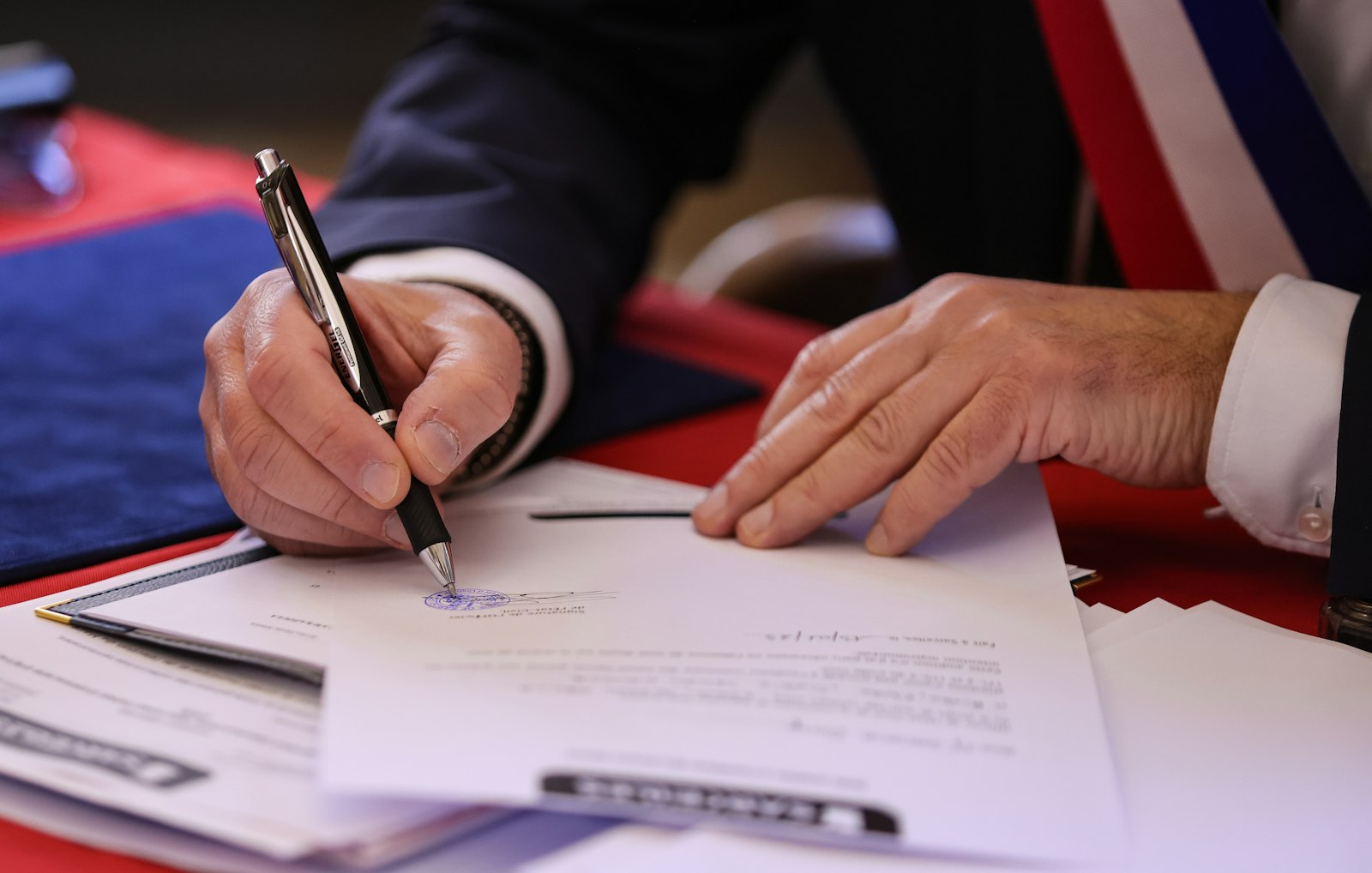
When the transaction happens, the agent signs their own name and states the capacity in which they are acting.
| Approach | Correct? |
|---|---|
| Your own signature, with capacity stated as attorney-in-fact | Yes |
| Forging the owner’s signature | No — a criminal offence |
| Your own signature with no capacity stated | Ambiguous, and likely rejected |
| The owner’s name written in your handwriting | No |
Bring the original power of attorney to the appointment. A photocopy will generally not be accepted, and the agent needs their own current photo identification alongside it.
Where the power of attorney is signed
A point that confuses people: the owner does not have to be in Pennsylvania to grant the authority.
A power of attorney can be notarized wherever the owner happens to be, including in another state, and a notarial act valid where it was performed is generally accepted here. The completed original is then sent to whoever will be handling the transaction.
That is the whole mechanism. It moves the in-person requirement from a Pennsylvania notary counter to whatever notary is available to the owner — which is why deployment and out-of-state residence are solvable rather than fatal.
Situations where this comes up
- Military deployment. The most common legitimate use, and one the forms are designed around.
- An owner living out of state who inherited or is disposing of a vehicle here.
- Illness or hospitalisation preventing attendance.
- A co-owner on an ‘and’ title who cannot be present — see two names on a PA title.
- An estate where a personal representative acts, though that usually runs through different documentation.

Where care is needed
A power of attorney over a vehicle is a genuine grant of control, and the abuse pattern is well known: a relative obtains authority for one purpose and uses it for another.
Two habits reduce that risk. Keep the authority narrow — a document naming one vehicle and one transaction cannot be stretched. And avoid having the other party to the transaction act as agent, because a buyer signing on the seller’s behalf removes exactly the independence the process exists to create.
We notarize vehicle powers of attorney and process the resulting transfers at our Bethlehem title transfer service, and can tell you on the phone whether the document you hold will work. PennDOT sets out the requirements in its secure power of attorney fact sheet.
Frequently asked questions
Can someone else sign a car title for me in Pennsylvania?
Yes, with a valid power of attorney authorising them to do so. Pennsylvania recognises three types in connection with vehicle title transfers: a secure power of attorney, a general power of attorney, and a third party limited power of attorney.
Does a vehicle power of attorney have to be notarized?
A motor vehicle power of attorney must either be notarized, or include a signature verification by an issuing agent who is a licensed dealer. In practice, most are notarized.
Does a general power of attorney work for a title transfer?
It can, but it carries stricter execution requirements — a general power of attorney must be notarized and include the signatures of two witnesses. That reflects Pennsylvania’s general rules for powers of attorney.
How do I sign as someone’s agent?
Sign your own name and state the capacity in which you are signing, so the document shows clearly that you signed as attorney-in-fact for the owner rather than as the owner yourself.
Can the buyer act as the seller’s agent?
It is generally a poor idea. Having one party to a transaction sign for the other removes the independence the paperwork is meant to establish, and it invites questions later. Use a neutral third party where possible.
Does a vehicle power of attorney expire?
These are typically transaction-specific rather than open-ended, covering an identified vehicle and a defined action. That narrowness is the point — it authorises the paperwork without granting broader control.
Seller or buyer cannot attend?
Call before you arrange anything — we will tell you which power of attorney your situation needs and what has to be on it. Hablamos Español.